
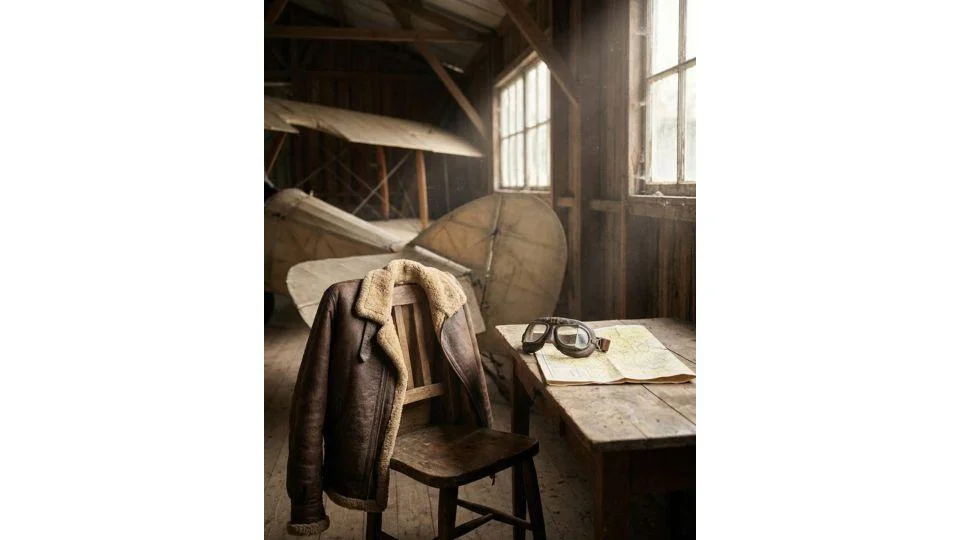
The flight jacket exists because flying is cold, windy and cramped. Early aviators in open cockpits wore long leather coats; in 1931 the US Army Air Corps approved the short, zip-front A-2, and every later jump in altitude, speed and fire risk produced a new design, from the sheepskin B-3 to the nylon MA-1 and the flame-resistant CWU-45/P. Read the history as a chain of problems and solutions and every detail on a modern jacket starts to make sense.
Flight jacket history at a glance
The table below links each era to the problem aircrews faced and the jacket that answered it. Dates are given as precisely as reliable sources allow; where collectors and archives disagree, we use a range.
| Era | The flying problem | Jacket it produced | Design answer |
|---|---|---|---|
| WWI (1914–1918) | Open cockpits, wind blast, engine oil spray | Long leather flying coats, often fur- or fleece-lined | Windproof leather, high wraparound collars, full length for warmth |
| Late 1920s | Long coats were clumsy in a cockpit | Army Air Corps Type A-1 | Waist length, knit collar, cuffs and waistband, button front |
| 1931 | Need for a tougher, quicker-to-close summer jacket | Type A-2 | Zip front, leather shirt-style collar, horsehide shell, knit cuffs and waist |
| 1934 | Altitude cold in open and unpressurized aircraft | Type B-3 sheepskin jacket | Shearling throughout, tall buckled collar, waist strap |
| Late 1930s to 1947 | Navy aviators wanted their own intermediate jacket | M-422 and M-422A, later named G-1 | Goatskin, mouton fur collar, pleated action back |
| 1942–1945 | Leather shortages and the need for lighter layers | Fabric jackets such as the B-10 and B-15 | Cotton, later nylon shells with pile linings and fur collars |
| 1950s–1960s | Jets, helmets and parachute harnesses | MA-1 nylon jacket | Knit collar, lightweight nylon, utility sleeve pocket, later an orange lining |
| 1970s | Nylon melts in a cockpit fire | CWU-45/P | Flame-resistant aramid shell and insulation |
| Late 1980s | Tradition and morale | A-2 returns for USAF aircrew; Navy G-1 restored | Classic leather patterns reissued for wear on the ground |
Open cockpits: why the first flight clothing was long and heavy
World War I pilots sat in open cockpits with a propeller pushing freezing air straight at them. Rotary engines also threw out a fine mist of castor oil. Leather was the obvious answer: it blocks wind, sheds oil and survives rough handling. Early flying coats were long, double-breasted and often lined with fur or fleece, with tall collars that could be wrapped around the face.
The trouble was bulk. A long coat tangles around controls and makes climbing in and out of a cockpit awkward. That single complaint, too much coat for too little space, drove the next decade of design.
The short leather jacket arrives: A-1 to A-2
By the late 1920s the Army Air Corps had standardized a waist-length leather jacket, the Type A-1, with a knit collar and a button front. It solved the length problem but buttons were slow and the knit collar offered little wind protection.
In 1930 the Air Corps wrote a new specification, and production of the Type A-2 was approved on May 9, 1931. The changes were small on paper and big in practice: a zipper replaced the buttons and a leather shirt-style collar replaced the knit one. The original specification called for seal-brown horsehide with a silk lining, later swapped for cotton or rayon. Knit wool cuffs and waistband kept drafts out, and two snap-flap patch pockets and shoulder straps completed a look that barely changed afterwards.
The A-2 was officially a summer jacket, but crews wore it everywhere and painted it with squadron art and bomb tallies. Our A-2 flight jacket history covers its full story and how to judge a reproduction.
The Navy's parallel path: from M-422A to G-1
The Navy developed its own leather jacket alongside the A-2. The Smithsonian's National Air and Space Museum records that the style has been regulation issue to naval aviators since 1938, was standardized as the M-422A in 1940 and was redesignated Type G-1 in 1947. It used goatskin rather than horsehide, a mouton (sheared sheepskin) fur collar and a pleated action back for reaching across a cockpit. Read the full G-1 flight jacket history for how the specification changed over the decades.
Altitude changes everything: sheepskin and the B-3
As bombers climbed higher, the threat changed from wind to deep cold. The National Museum of the US Air Force notes that crews at high altitude faced temperatures as low as 50 degrees below zero Fahrenheit, and that early bomber crewmen relied on thick sheep shearling clothing. The Type B-3, issued in 1934, put shearling on the inside of a leather shell from collar to cuff. It stayed in service through World War II and became the jacket most closely tied to bomber crews. See our B-3 bomber jacket history for why every detail was built around that cold.
Wartime shortages and the move to fabric
Leather was expensive and slow to source in wartime quantities. According to Air Force Magazine, Gen. Henry H. Arnold cancelled the A-2 order in 1942 because he wanted something better. Its successor, the B-10, used olive-drab cotton twill with an alpaca and wool pile lining and a fur collar, while keeping the A-2's knit cuffs and waistband.
The B-15 followed in the mid-1940s and, after the war, moved from cotton to nylon. This was the real turning point: flight jackets were no longer defined by leather, and the fabric jacket with a fur collar became the bridge to the jet age.
The jet age: nylon, knit collars and the MA-1
Jets brought enclosed, heated cockpits but new constraints: ejection seats, bulky helmets and parachute harnesses that crossed the shoulders. A fur collar got in the way, so the MA-1 swapped it for a knit collar. The shell was lightweight nylon, the color was sage green, and a zipped pocket on the left sleeve held pens. From the early 1960s, according to collector records of contract jackets, the MA-1 gained its famous orange lining so the jacket could be reversed for visibility. Our MA-1 jacket history unpacks that lining story and how the jacket moved into streetwear.
Fire safety: why Nomex® replaced nylon
Nylon has one serious weakness in a cockpit: it melts and drips in a fire. From the 1970s the US military moved aircrew to jackets made from aramid fibers, with the CWU-45/P becoming the standard cold-weather flyer's jacket. Nomex® is a meta-aramid fiber developed by DuPont; since April 2026 the brand has been owned by Arclin, which bought DuPont's aramids business. Aramid fabric is flame resistant, which means it resists ignition and does not melt, not that it is immune to fire, and the MA-1's nylon offers no flame resistance at all. Fashion and heritage garments are not certified PPE; do not rely on them for firefighting, welding or other fire hazards. Our guide to what Nomex is explains the fiber in more depth.
Back to leather: the A-2 and G-1 return
Leather never fully disappeared. The Navy discontinued the G-1 for a period in the 1970s and restored it in the early 1980s; sources differ on the exact years. The Air Force brought the A-2 back for aircrew in the late 1980s, with Air Force Magazine reporting that the first new goatskin jackets were delivered in May 1988. Both are worn on the ground and as dress-casual items rather than as cockpit gear, a sign of how much the jackets had become about identity as well as protection.
How military jackets became everyday wear
Surplus stores put A-2s, B-15s and MA-1s into civilian hands after each war, and returning servicemen kept wearing them. From there the jackets moved through subcultures, including British skinheads and punks, Japanese Americana fans and, later, hip-hop and streetwear. The word bomber jacket now covers almost any waist-length jacket with a zip front and ribbed cuffs and hem, whether or not any bomber crew ever wore it. Our explainer what is a bomber jacket sorts out the terms and types.
Reading the history when you shop
Knowing where a feature came from helps you choose a jacket that suits how you live:
- Knit cuffs and waistband come from the A-1 and A-2 era and seal out drafts. They suit anyone who wants a neat, short silhouette.
- A leather shirt collar (A-2) is the cleanest, most versatile look; a mouton or shearling collar (G-1, B-3) adds warmth and character.
- Shearling throughout (B-3) is built for real cold and can be too warm for mild climates or heated cars.
- Nylon with a knit collar (MA-1) is light, packable and easy to layer, but it is not flame resistant.
- Aramid shells (CWU-45/P) are flame resistant but still not certified protective equipment when bought as fashion or heritage pieces.
If you want to see how these lines look today, browse our leather flight jackets, the nylon and textile flight jackets that follow the B-15 and MA-1 patterns, and our Nomex® flight jackets and gear. Each product page lists the actual shell fabric, so check it before relying on any feature described here.
Flight jacket history FAQ
What was the first flight jacket?
Flying coats were worn from the earliest days of military aviation, but the first standardized short flight jacket in the US was the Army Air Corps Type A-1 of the late 1920s. The A-2 of 1931 is the first design most people would recognize today.
Why are they called bomber jackets?
The name stuck to warm, waist-length jackets worn by aircrews in World War II, especially the sheepskin B-3 associated with bomber crews. Today it is a fashion term that covers many jackets that were never issued to bomber crews.
Do pilots still wear leather flight jackets?
Yes, but mostly on the ground. US Air Force aircrew wear the A-2 and naval aviators the G-1 as part of their uniforms, while flight gear for the cockpit itself is made from flame-resistant aramid fabrics.
Sources
Facts in this article were checked against Smithsonian National Air and Space Museum: Type A-2 jacket, Flak-Bait, Smithsonian NASM: Type G-1 jacket, Air Force Magazine: The Jacket That Lives Forever and National Museum of the US Air Force: Combat Box fact sheet.


