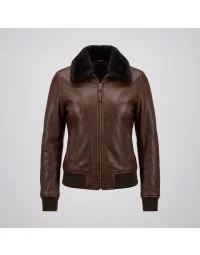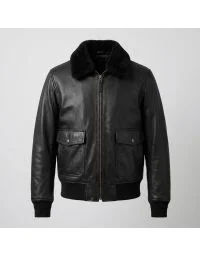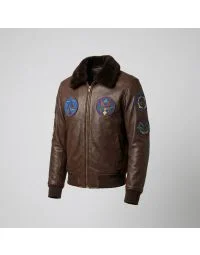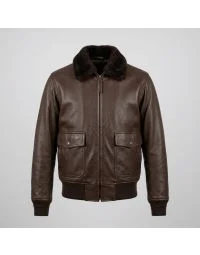
The G-1 is the US Navy's leather flight jacket: waist-length goatskin with a mouton fur collar, a pleated action back, knit cuffs and waistband and two button-flap pockets. The Smithsonian's National Air and Space Museum records that the style has been regulation issue to Navy, Marine Corps and Coast Guard aviators since 1938, was standardized as the M-422A in 1940 and took the name Type G-1 in 1947. Unlike most flight jackets of its era, it never really left service.
Anatomy of the G-1
Each feature answers a problem a naval aviator actually had. This breakdown follows the jacket from top to bottom.
- Mouton fur collar. Mouton is sheepskin with the wool sheared short and treated so it looks like a short, dense fur. It turns up to shield the neck from wind on an open deck or in a drafty cockpit. Later specifications allowed synthetic mouton.
- Goatskin shell. Goatskin is lighter and more flexible than horsehide, with a pebbled grain that hides scuffs. It suited carrier life, where jackets met salt air and rough handling.
- Action back (bi-swing back). Pleats behind the shoulders open when you reach forward, so the jacket does not pull tight across the back when you stretch for controls or switches.
- Knit cuffs and waistband. Wool knits seal the wrists and hem against wind, the same solution the Army used on the A-2.
- Button-flap patch pockets. Two lower pockets with flaps keep items from falling out. Many versions add a pencil slot in the left pocket flap, a small detail that tells you this was working flight gear.
- Underarm gussets. Many G-1 patterns include gussets or extra room under the arms for the same reason as the pleated back: reach.
- Front zip. A heavy zip runs the length of the front, usually with a wind flap behind it.
How the G-1 changed over the decades
The Navy jacket evolved through a series of specifications. Collectors use these names to date surviving jackets, but exact years differ between sources, so the table uses approximate periods.
| Designation | Approximate period | What changed or stood out |
|---|---|---|
| M-422 | Late 1930s | The first Navy intermediate leather jacket with mouton collar and action back |
| M-422A | Standardized 1940 | Refined pattern produced in large numbers through World War II |
| AN-J-3 / AN6552 | Wartime, around 1943 | Joint Army-Navy designations from the war years; collectors disagree on how different these jackets really were |
| 55J14 | From 1947 | The first specification labelled Type G-1 |
| MIL-J-7823 series | 1950s onward | Successive revisions for modern contracts, eventually permitting synthetic mouton and changing lining materials |
| Break and return | 1970s to early 1980s | Issue was suspended for a period and later restored; sources disagree on the exact years |
Whatever the designation, the silhouette barely changed. A jacket from the 1940s and one from the 2010s look recognizably alike, which is rare in military clothing.
Why the G-1 stayed while others disappeared
The Army moved from leather to fabric jackets during World War II and stopped issuing the A-2 for decades. The Navy kept its leather jacket in use far longer. Part of the reason was practical, because it was a sturdy, moderately warm intermediate layer. Part was identity: the G-1 marks someone as a naval aviator, and that symbolism has kept it popular with pilots and the public. 1980s naval aviation films made it famous far beyond the fleet, but its standing inside naval aviation came first.
Patches and personalization
Real G-1s are often decorated with a leather name tag, wings and squadron patches, and the Smithsonian's own example carries a name tag and a squadron insignia. For a civilian jacket, use original designs or licensed patches rather than copying a real unit's insignia. Our flight jacket patches guide covers placement and the history of the practice, and our squadron-style collection shows jackets with patch-ready details.
Choosing a G-1 style jacket today
- Collar: real mouton is softer and warmer; synthetic is easier to care for. Both brush back into shape.
- Back: check that the action pleats are actually functional, not just stitched lines.
- Hide: goatskin is the traditional choice; cowhide is heavier and stiffer at first.
- Fit: the G-1 is usually cut slightly fuller than an A-2 through the back thanks to the pleats. Compare measurements on the size guide.
Browse our G-1 flight jackets, which are military-pattern jackets inspired by the Navy original, and see A-2 vs G-1 if you are deciding between the two classics.
Caring for the mouton collar
The collar is the part of a G-1 that shows wear first, because it collects hair oil, skin oils and rain. Brush it gently with a soft brush after wear to lift the pile, let it dry naturally at room temperature if it gets wet, and keep it away from radiators. Before using any cleaner or conditioner on the collar or the goatskin, do a spot test on a hidden area and follow the garment's care label. For a valuable or vintage jacket, take it to a professional leather cleaner rather than experimenting at home.
G-1 jacket FAQ
What is a mouton collar?
It is a collar made from sheepskin whose wool has been sheared short and treated to look like a smooth, dense fur. It is warm, soft and turns up against wind.
Is the G-1 warmer than the A-2?
Slightly, mainly because of the fur collar. Both are intermediate-weight jackets rather than true winter coats; treat that as guidance, not a rating.
Can civilians wear a G-1?
Yes. Civilian G-1 style jackets are widely made and worn. Just avoid real unit insignia or rank you are not entitled to.
Sources
Designation dates come from the Smithsonian National Air and Space Museum record for a Type G-1 jacket. Intermediate specification names (AN-J-3, 55J14, MIL-J-7823) follow collector research and are given as approximate periods.