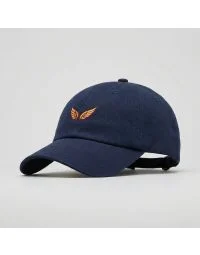
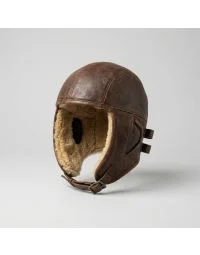
An aviator hat is a close-fitting leather cap with ear flaps and a chin strap, modelled on the soft flying helmets pilots wore in open cockpits from the First World War to the 1940s. Those helmets kept the head warm in a freezing slipstream, held goggles in place and, later, carried radio earphones. Today "aviator hat" also covers fur-lined winter trapper hats inspired by the same look, which fit and work quite differently.
Because a leather helmet fits snugly around the skull, sizing matters more than with almost any other hat. The measuring method below is the part most guides skip.
A short history of the flying helmet
Open cockpits, 1910s to 1920s
Early pilots borrowed from motoring: leather caps, goggles and heavy coats. As aircraft flew higher and faster, the cap became a purpose-made helmet that covered the ears and fastened under the chin. The US Army Air Service standardised a leather flying helmet with moulded leather ear cups in 1917, a design that stayed in use into the mid-1920s, according to the Smithsonian's National Air and Space Museum.
Radio arrives, 1930s to 1940s
Once aircraft carried radios, helmets had to hold earphones. Ear areas changed from plain leather to raised rubber or leather mountings that seated a receiver over each ear. Linings varied with the season: sheepskin or shearling for winter, chamois or cotton for intermediate and summer types. The US Army Air Forces adopted the Type A-11 intermediate helmet in August 1943, and it became one of the most widely used American helmets of the war. Its earphone mountings were made for the standard radio receivers of the day, and production changes mostly concerned oxygen mask fittings.
The jet age, 1950s onward
Jets made the soft helmet obsolete. Higher speeds, buffeting and ejection seats demanded hard protective shells, and by the 1950s hard helmets with integrated communications had replaced leather in military flying. Test pilots in the late 1940s sometimes fitted hard shells over their leather helmets as a stopgap. The leather helmet lived on in vintage aircraft, open-cockpit biplane rides and, of course, fashion.
How to measure your head for an aviator hat
A leather helmet sits lower and closer than a baseball cap or fedora, so measure where it will actually sit.
- Use a soft tape measure. A cloth or vinyl sewing tape. If you only have string, mark it and measure the string against a rigid ruler.
- Find the line. Run the tape across the middle of your forehead, about a finger's width above your eyebrows, just above the tops of your ears, and around the fullest part of the back of your head.
- Keep it level and snug. Firm enough not to slip, not so tight it presses in. Check in a mirror that it is not riding up at the back.
- Measure twice. Take two or three readings and use the largest. Note it in both inches and centimetres.
- Allow for hair. If you have thick or long hair, or plan to wear the hat over a thin beanie or balaclava, measure with that in place.
- Match to the chart. Compare your number with the chart on our size guide or the product page. Hat sizing systems vary between makers, so do not assume your fitted-cap size carries over.
- Between sizes? With a lined leather helmet, go up. Leather gives a little over time, but a cap that is too tight from day one is uncomfortable, and a slightly loose one can be snugged with the chin strap.
Signs of a good fit: the crown sits evenly with no gap on top, the ear flaps cover your ears without pressing them flat, and the chin strap closes comfortably with a finger's width to spare.
Flying helmet vs winter trapper hat
Both get called aviator hats, and they are often shopped together. They do different jobs.
| Feature | Leather flying helmet | Winter trapper hat |
|---|---|---|
| Origin | Open-cockpit aviation, 1910s to 1940s | Cold-climate fur hats, borrowed by aviators and later by fashion |
| Fit | Close to the skull, fitted by head size | Roomier; often sized small, medium, large |
| Lining | Thin: chamois, cotton, or a light shearling | Thick fur or shearling, often with a fur front brim |
| Ear flaps | Integral, fitted, close to the ears | Large flaps that tie up on top or down under the chin |
| Warmth | Moderate; designed for wind more than deep cold | High; built for standing around in winter |
| Goggles | Designed to hold them at the brow | Not designed for them |
| Best for | Vintage looks, costumes, open-cockpit rides, cool windy days | Real winter weather |
As guidance, not a rating: a fitted leather helmet is comfortable on cool, windy days, while a trapper is the better pick for sustained cold below freezing.
Wearing and caring for a leather aviator hat
A leather helmet looks best with other period pieces: a leather flight jacket and a silk scarf tucked at the collar. The scarf did a real job here, closing the gap where wind got in between helmet and coat, as explained in why pilots wore silk scarves. For a full head-to-toe period look, see how to dress like a 1940s aviator.
For care, wipe the outside with a slightly damp cloth, let it dry naturally away from heaters, and condition the leather sparingly after a spot test on a hidden area. Never put it in a washing machine. Follow the care label, especially with fur or shearling linings, and take a vintage original to a professional leather cleaner. Store it stuffed with tissue so it keeps its shape.
You can browse leather helmets, trappers and other headwear in our caps and hats collection; each product page lists materials and sizing.
Aviator hat FAQ
Can I wear a leather flying helmet for an open-cockpit flight?
Biplane ride operators usually supply or approve headgear, often with a headset. Ask them first; a fashion helmet is not a certified protective helmet.
Will a leather aviator hat stretch?
Slightly, as the leather warms and shapes to your head. Do not rely on it stretching a full size.
What is the difference between an aviator cap and an aviator hat?
The terms are used interchangeably. "Cap" more often means the fitted leather helmet; "hat" is also used for fur trappers.
Sources
Helmet dates and features were checked against the Smithsonian NASM: Helmet, Flying, Type A-11 and Smithsonian NASM: Helmet, Flying, US Army Air Service collection records.