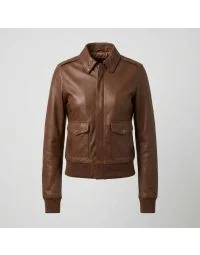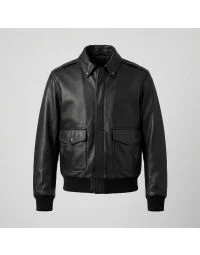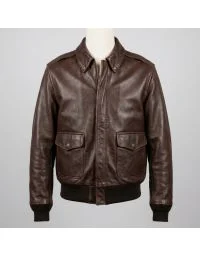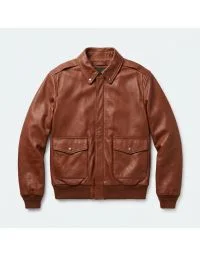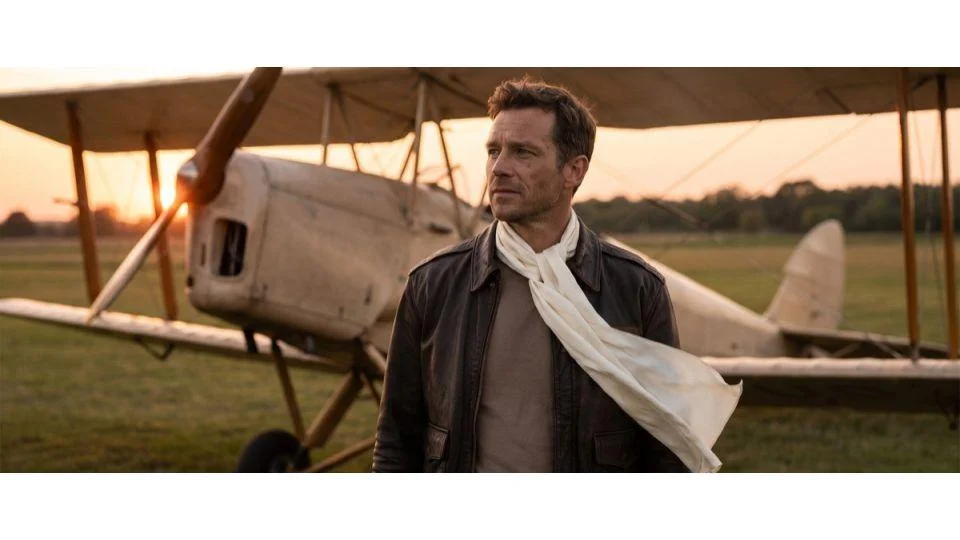
A convincing 1940s aviator outfit comes down to five pieces: a brown leather flight jacket such as the A-2, a khaki or olive shirt with a tie, khaki or olive trousers, brown leather boots or shoes, and headgear, either a leather flying helmet with goggles or a soft-crowned service-style cap. Add a scarf and leather gloves and you are done. Everything else is detail, and the details are where you choose between a quick costume and a look you could also wear in real life.
Below is the full kit list, with a budget costume option and a heritage-look option for each piece, followed by the variations for fighter pilots, bomber crews and naval aviators.
The silhouette you are aiming for
Second World War aircrew photographs share a consistent outline: a short leather jacket ending at the waist, often worn open or half-zipped over a collared shirt and tie; high-waisted, straight, slightly full trousers; sturdy brown shoes or boots; and a cap pushed back or a helmet with goggles on the forehead. The look is practical, a little rumpled and very brown and khaki. Keep to that palette and the outfit reads as 1940s even if every piece is new.
The head-to-toe kit list
| Piece | Costume option (budget) | Heritage-look option | Getting it right |
|---|---|---|---|
| Flight jacket | Brown faux-leather zip jacket with knit cuffs and waist | Leather jacket inspired by the original A-2 pattern: snap-down collar, epaulets, knit cuffs and waistband | The hem should sit at the belt; too long looks like a modern coat |
| Shirt | Plain khaki or olive button-down | Cotton twill shirt with two flap pockets and a point collar | Collar worn over a tie or open at the neck |
| Tie | Any plain khaki, olive or black tie | Wool or cotton tie in khaki or olive, tucked between shirt buttons | Tucking the tie into the shirt front is a period detail |
| Trousers | Khaki chinos | High-rise, pleated or flat-front wool or cotton trousers in khaki or olive | Straight leg, no skinny fits, worn at the natural waist |
| Footwear | Brown lace-up boots or shoes you already own | Brown leather service-style shoes or plain-toe boots | Avoid sneakers; they break the look instantly |
| Headgear | Costume leather-look helmet with toy goggles | Leather flying helmet with real-glass goggles, or a soft-crowned cap | Choose helmet or cap, not both |
| Scarf | White polyester scarf | White or cream silk scarf, loosely knotted | Mainly a fighter-pilot detail; leave it off for bomber crew |
| Gloves | Brown knit or faux-leather gloves | Brown leather pilot-style gloves | Carry them in one hand in photos |
| Wings and patches | Novelty wings pin | Original-design or licensed patch, or none | Avoid real rank, medals and unit insignia |
| Extras | Inflatable-look yellow vest prop, map case | Field-style wristwatch, aviator sunglasses | One or two props is plenty |
Piece by piece
The jacket
The A-2 is the jacket most people picture. First made for the US Army Air Corps in 1931, it became the standard leather flying jacket of American airmen through the Second World War, and many crews had their jackets painted with art and mission tallies. For a heritage look, choose a jacket inspired by that pattern in brown leather: our A-2 flight jackets follow the classic shape with knit cuffs and waistband and a snap-down collar. Check the size guide so the hem lands at your belt.
Painted backs are tempting, but copying a real crew's artwork or a real unit emblem is best avoided. A plain back looks more authentic to most photographs anyway, since many jackets were never painted.
Shirt, tie and trousers
Officers in period photos very often wear a collared shirt and tie under the A-2, even on the flight line. A khaki or olive shirt with a matching tie is the single detail that most improves a costume. Trousers should be straight and high-waisted; modern slim chinos look wrong under a short jacket because they emphasize the gap at the waist.
Headgear
Two choices, and they tell different stories. A leather flying helmet with goggles says you are about to fly; it suits the open-cockpit and early-war look and photographs well. Our history of the leather flying helmet explains how they evolved and why earphone cups appeared. A soft-crowned peaked cap with the stiffening removed, worn slightly crushed, says you have just landed. Our caps and hats include aviator-style headwear for both versions.
Scarf
Fighter pilots wore silk scarves for a practical reason: constantly turning the head to scan the sky chafed the neck against a rough collar. Read why pilots wore silk scarves for the full story, and see our aviator scarves for white and patterned options. Knot it loosely and tuck one end into the jacket.
Gloves, watch and small props
Brown leather gloves, a simple field-style watch and maybe a pair of aviator sunglasses finish the outfit. Our aviation accessories collect gloves, scarves, caps and patches in one place.
Variations: which 1940s aviator are you?
| Character | Jacket | Signature details |
|---|---|---|
| Fighter pilot | Leather A-2 | Silk scarf, leather helmet and goggles, gloves |
| Bomber crew at altitude | Sheepskin B-3 with a large shearling collar | Sheepskin trousers or heavy trousers, fleece-lined boots, leather helmet |
| Naval aviator | Goatskin jacket with a fur collar (the ancestor of the G-1) | Khaki shirt and trousers, soft cap |
| Off-duty flyer | A-2 worn open | Crushed cap pushed back, shirt and tie, hands in pockets |
| Ground crew | Work jacket or coveralls | Rolled sleeves, a rag in the back pocket, no helmet |
High-altitude bomber crews flew in unheated aircraft where the air could fall far below freezing, which is why sheepskin outfits existed. A B-3 look is the warmest and most dramatic choice for a winter party.
Women's 1940s aviator looks
Women flew too, including the Women Airforce Service Pilots (WASP), who ferried and tested aircraft in the United States during the war. A women's version follows the same pieces: leather flight jacket, khaki shirt, high-waisted trousers, brown shoes and a cap or turban-style scarf. For an earlier, 1930s look built around a long leather coat, see our Amelia Earhart costume guide.
Hair, grooming and how to wear it
Small styling choices do as much as the clothes. Men's hair in the period was short at the back and sides with more length on top, combed back or side-parted with a little shine; a clean shave or a neat, narrow mustache fits. Women's hair was usually set in soft rolls or curls, often pinned up so it would fit under a cap or helmet. A simple red lipstick is a very 1940s finishing touch.
Then wear the outfit with ease. The jackets in period photos are creased, unzipped, worn with hands in pockets or slung over a shoulder. A brand-new jacket zipped to the chin with everything perfectly pressed looks more like a mannequin than a flyer, so leave the collar open, push the cap back and let the jacket move. If your leather jacket is new, our guide to breaking in a leather jacket will help it soften faster.
Planning by occasion
- Halloween or a themed party: go full kit with helmet, goggles and scarf; props are welcome.
- Swing dance or 1940s weekend: choose the cap rather than the helmet so you can dance, and wear comfortable leather-soled shoes.
- Air show or museum visit: jacket, shirt and chinos only; the subtle version suits a day on your feet.
- Photo shoot: add texture with gloves in hand and a map case, and shoot near anything vintage with wings.
Costume to everyday: making it wearable after the party
The advantage of a heritage-look jacket over a costume jacket is that it keeps working afterwards. Take away the helmet, goggles, tie and props and you have a leather jacket, a shirt and chinos, which is simply a good outfit. That is a useful test when deciding where to spend: put the money into the jacket and boots, and keep the props cheap.
Respect and accuracy
- Avoid real medals, rank insignia and unit emblems. Wearing decorations you did not earn can upset veterans and their families.
- Choose original or licensed patch designs if you want decoration.
- If you are dressing as a specific real person, describe them from photographs and do not imply any connection to them or their family.
FAQ
What did WW2 pilots wear under their jackets?
Typically a collared uniform shirt, often with a tie, and wool or cotton uniform trousers. At high altitude, crews added sheepskin or electrically heated suits.
Is a bomber jacket the same as a 1940s flight jacket?
Not quite. The leather A-2 and sheepskin B-3 are 1940s flight jackets; the nylon MA-1 bomber came later, in the jet age. For a 1940s outfit, choose leather.
How do I make a quick DIY aviator costume?
Brown jacket, khaki shirt, khaki trousers, brown boots, a white scarf and goggles. Five minutes, mostly from your wardrobe.
Sources
A-2 origins and wartime use: Flight jacket (Wikipedia) and National Museum of the US Air Force, A-2 Jacket with Art.