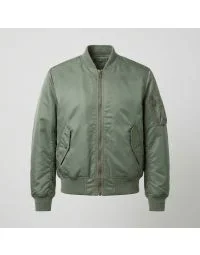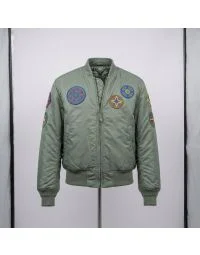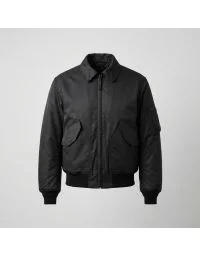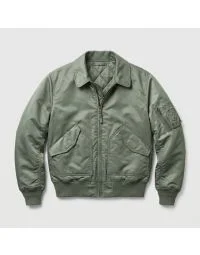
The short version: the B-15 is the 1940s fabric jacket with a fur collar, the MA-1 is its 1950s jet-age nylon successor with a knit collar, and the CWU-45/P is the 1970s replacement made from flame-resistant aramid with a flat knit collar and a straighter, longer cut. The L-2B is the MA-1's lightweight summer sibling. If you want a warm everyday jacket, the MA-1 or B-15 style will do; if flame resistance matters for your story or hobby, only a genuine aramid CWU-45/P has it, and even that is not certified protective equipment when bought as a heritage piece.
The four jackets side by side
Warmth descriptions are guidance, not ratings. Flame resistance refers to the original military fabric; retail versions vary, so always check the product page.
| Feature | B-15 | L-2B | MA-1 | CWU-45/P |
|---|---|---|---|---|
| Era | Mid-1940s into the 1950s | 1950s onward | 1950s to 1970s in service | 1970s to today |
| Collar | Mouton or faux fur | Knit | Knit | Flat knit collar |
| Shell fabric | Cotton early, then nylon | Light nylon | Nylon | Aramid (Nomex®) twill |
| Flame resistance | None | None | None; nylon melts | Flame resistant fabric and insulation |
| Warmth | Cool to cold | Mild | Cool | Cool to cold |
| Fit and length | Waist length, roomy | Waist length, light | Waist length, blousy over knit band | Straighter body, a little longer, with a knit waist |
| Pockets | Slanted front pockets, sleeve pocket on later models | Slash or flap pockets, sleeve pen pocket | Two flap pockets, zipped sleeve pen pocket | Two hand pockets with flaps, sleeve pen pocket, inside pockets |
| Best everyday use | Cold commutes with a vintage look | Spring and early fall | All-round layering jacket | Clean, utilitarian look; aviation hobbyists |
B-15: the bridge from leather to nylon
The B-15 arrived near the end of World War II as part of the shift away from leather. Early versions used cotton; after the war the shell moved to nylon. Its fur collar kept necks warm but, as jets arrived, it was widely reported to interfere with helmets and parachute harness straps. If you like a fur collar but want something lighter and easier to care for than leather, our B-15 flight jackets follow that pattern.
MA-1: the jet-age classic
The MA-1 dropped the fur for a knit collar, kept the knit cuffs and waistband, and added a zipped pen pocket on the sleeve. From the early 1960s many had an orange lining so they could be reversed for visibility. It is light, packable and easy to wear, which is why it became the default bomber jacket in fashion. Its one big weakness in a cockpit was nylon's behavior in a fire. Read the full MA-1 jacket history for the lining story and its route into streetwear, or browse our MA-1 bomber jackets.
L-2B: the lightweight sibling
The L-2B shares the MA-1's knit trim and nylon shell but carries much less insulation, so it was the light-weather jacket of the same jet-age family. L-2 series jackets also typically have snap-down epaulets, which the MA-1 lacks. For civilians it is the easiest of the four to wear on warm evenings or under a heavier coat. Like the MA-1 and nylon B-15, it offers no flame resistance.
CWU-45/P: built around flame resistance
In the 1970s the US military replaced nylon flight jackets with jackets made from aramid fibers, and the CWU-45/P became the standard cold-weather flyer's jacket. Its lighter sibling, the CWU-36/P, covers warmer weather. The design changed as well as the fabric: a flat knit collar, a straighter body that sits a little lower, a knit waistband and cuffs, and roomy hand pockets.
Nomex® is a meta-aramid fiber developed by DuPont; since April 2026 the brand has been owned by Arclin, which bought DuPont's aramids business. Meta-aramid resists ignition and chars rather than melting, which is why it replaced nylon in the cockpit. Our guide to Nomex covers how the fiber works and how to care for it. You can find the pattern in our CWU-45/P Nomex® pilot jackets.
Flame resistance: the caveats that matter
- Flame resistant is not fire immune. Aramid fabric resists ignition and does not melt and drip, but it can still char and transfer heat.
- Look at the label, not the name. Many retail jackets are called CWU-45/P style but are made of nylon or polyester. Only an aramid shell offers flame resistance.
- MA-1, L-2B and B-15 jackets in nylon are not flame resistant. Keep them away from open flames, campfires and sparks.
- Heritage is not PPE. Fashion and heritage garments are not certified PPE; do not rely on them for firefighting, welding or other fire hazards.
Which one should you buy?
- You want one everyday jacket for three seasons: MA-1.
- You want warmth and a fur collar without leather: B-15.
- You want something for warm spring evenings: L-2B or a lightweight MA-1.
- You want the modern aviator look or an aramid jacket for an aviation hobby: CWU-45/P, checking that the shell is genuinely aramid.
Fit differs too. The MA-1 and B-15 blouse over their knit waistbands, so many people size for a close shoulder fit. The CWU-45/P hangs straighter. Compare your body measurements with the size guide rather than assuming your usual size carries over between patterns, or choose Made to measure and enter your own; see how made to measure works.
FAQ
Is the CWU-45/P warmer than the MA-1?
Usually slightly, thanks to its batting and longer body, but construction varies. Treat warmth as guidance, not a rating.
Is an L-2B the same as an MA-1?
No. The L-2B is a lighter-weight jacket for mild weather, while the MA-1 is an intermediate jacket with more insulation.
Can I wash a CWU-45/P?
Follow the care label. Aramid garments are often machine washable, but avoid chlorine bleach and fabric softener, and spot test any stain treatment first.
Sources
Background comes from the Wikipedia flight jacket article and the Arclin acquisition reported by Textile World (April 2026).