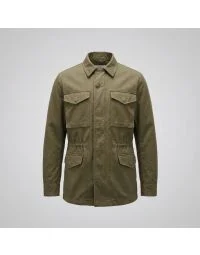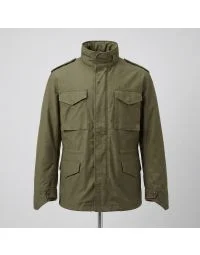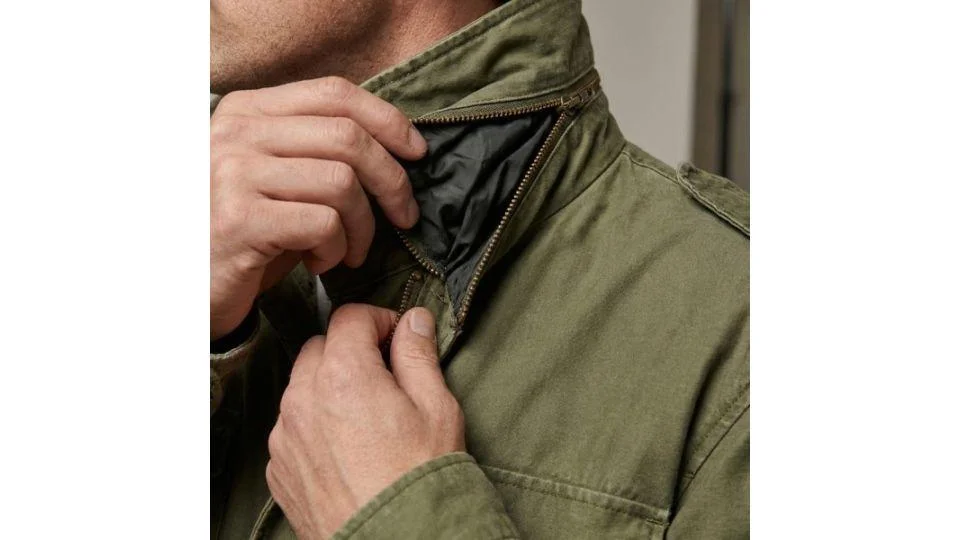
The M-65 replaced the M-51 as the US Army's field jacket in 1965, and the changes are easy to spot once you know where to look. The M-51 has a pointed shirt collar, a separate hood that buttons on, button cuff tabs and an all-cotton sateen shell. The M-65 has a taller stand collar with a hood rolled up inside it, hook-and-loop cuff tabs and, from 1966, a cotton-nylon shell. Both have four front pockets and a button-in liner, which is why they are so often confused.
Spot the difference: a quick checklist
Hold up the jacket and work down this list. Three or more matches in one column tell you which pattern you are looking at.
| Detail | M-51 | M-65 |
|---|---|---|
| Collar | Pointed shirt-style collar | Taller stand collar with a zipped compartment |
| Hood | Separate hood that buttons onto the collar | Thin hood stowed inside the collar; an extra fur-trimmed winter hood could button on |
| Cuffs | Button tabs | Hook-and-loop tabs |
| Front zipper | Aluminum zipper | Aluminum on early jackets, then brass, then nylon on late contracts |
| Storm flap | Snap fasteners | Snap fasteners |
| Shell fabric | Cotton sateen, wind resistant and water repellent | Cotton-nylon sateen on most issue jackets from 1966 |
| Liner | Button-in wool-pile liner | Button-in quilted liner |
| Pockets | Four front pockets | Four front pockets with snap flaps |
| Waist | Drawcord | Drawcord |
If you are buying vintage, the fastest single check is the collar. A pointed collar means M-51; a stand collar with a zip running along its top or back means M-65.
Why the M-65 changed things
The M-51 was itself an upgrade of the World War II M-1943 field jacket, swapping buttons for snaps and adding a zip and a warmer liner. The M-65, designed by Alpha Industries under specification MIL-C-43455, made three practical fixes:
- A hood you cannot lose. The M-51's hood was a separate item. Rolling a hood into the collar meant every soldier had one.
- Faster cuffs. Hook-and-loop tabs close quickly with cold or gloved hands, and the M-65 is often cited as one of the first mainstream garments to use it this way.
- Tougher fabric. Adding nylon to the cotton shell improved abrasion resistance while keeping the windproof sateen weave.
The M-65 stayed in US service until 2009, through Vietnam and well beyond, which is why it became the default field jacket for civilians too.
Buying vintage: what to check
Original jackets are now decades old. Before buying, check that the collar zip on an M-65 still runs and the hood is present, that snaps on the storm flap and pockets close firmly, and that the liner buttons are all there. Look inside for the contract label, which usually gives the size and specification, and check the elbows and cuff edges for wear. Small repairs are normal; torn seams around the pockets are harder to fix well.
Not the same as the M-51 parka
The M-1951 fishtail parka is a different garment: a long, hooded parka with a split tail that tied around the legs. It became a mod staple in 1960s Britain. When a seller says M-51 without saying parka or field jacket, check the photos. For longer cold-weather coats, see N-3B vs N-2B parka.
Layering and sizing a field jacket
Field jackets were designed as the outer layer of a system, so they are cut with room for a liner and a sweater underneath. That affects how you choose a size.
- Decide how you will use it. As a light spring and fall jacket over a T-shirt or shirt, you may prefer one size down from a full military cut. For winter with a liner and a sweater, stay at your normal size.
- Check the shoulder seam. It should sit at or just past your shoulder bone. Field jackets look sloppy when the shoulders hang well off.
- Sleeve length. Sleeves should reach the base of the thumb with arms at your sides; the cuff tabs take up any extra.
- Use the drawcord. Cinching the waist slightly gives the boxy cut shape and stops wind blowing up the back.
- Liner first. If the jacket takes a button-in liner, try it on with the liner fitted to be sure you are not buying a size that only works in summer.
Sizing varies by maker, so compare your body measurements with our size guide rather than relying on your usual size, or choose Made to measure with the Room for layers fit; see how made to measure works. Warmth depends heavily on what you layer underneath: treat any temperature range as guidance, not a rating.
How to wear one today
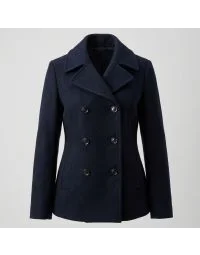
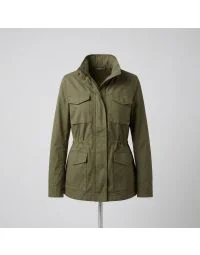
The M-65 works over a hoodie with jeans, over an oxford shirt with chinos, or over a knit with dark trousers. Keep the rest of the outfit plain and let the jacket's pockets and texture do the work. Our guide on how to wear a field jacket has full outfit ideas. Browse our M-65 field jackets, the wider range of field jackets and parkas, and our women's coats and field jackets, all military-pattern pieces inspired by the originals.
M-65 vs M-51 FAQ
Can an M-51 hood fit an M-65?
The button-on hood design carried over, and collectors report that M-51 hoods can be fitted to M-65 jackets, but fit varies by contract and maker. Check the button positions first.
Is an M-65 waterproof?
No. The tight sateen weave is wind resistant and, when treated, water resistant, but it is not waterproof. Wear a shell over it in heavy rain.
Which is better for everyday wear?
For most people the M-65, because the built-in hood and quick cuffs are more practical and modern versions are easy to find. The M-51 suits collectors who prefer its slimmer collar and older details.
Sources
Specification details come from the Wikipedia M-1965 field jacket article and the Wikipedia M-1951 field jacket article; zipper and fabric dates vary by contract.