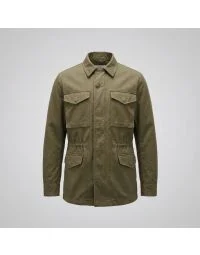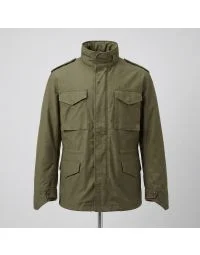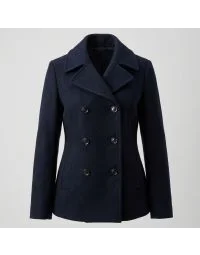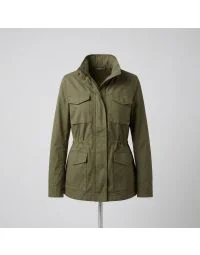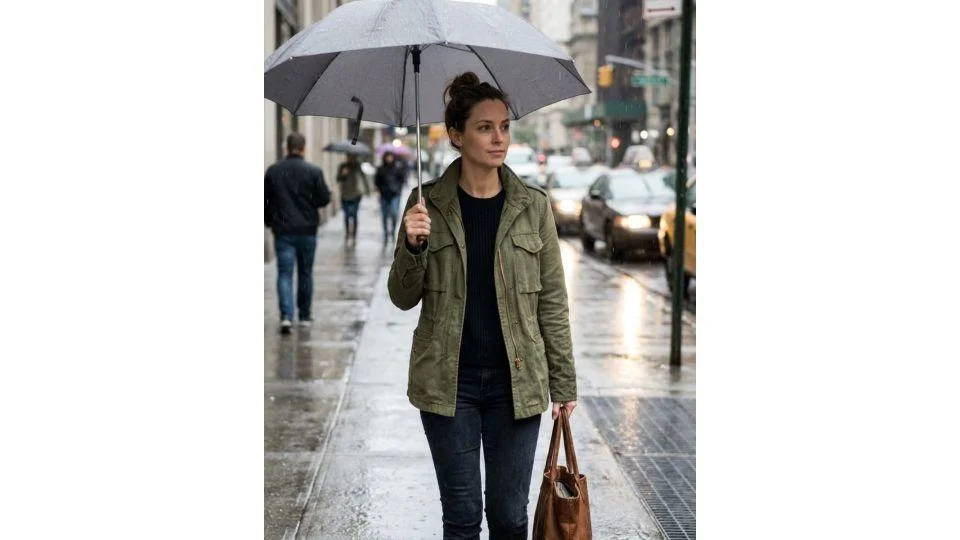
Wear an M-65 field jacket the way it was designed: as a shell over layers that you change with the weather. Over a tee or shirt it is a spring and fall jacket; add a sweater and it handles cool days; button in a quilted liner and it becomes a winter coat. Style-wise, pair it with denim, chinos or wool trousers and simple boots or sneakers, and avoid matching it with other military pieces so it reads as clothing rather than uniform.
What makes the M-65 different
The M-65 entered US service in 1965, replacing the earlier M-1951 field jacket. Its key features explain how to wear it:
- A wind-resistant cotton-blend shell, tightly woven and treated for water resistance, not insulated on its own.
- Buttons inside for a liner, so warmth can be added or removed.
- A thin hood rolled into the collar behind a zip, for sudden showers.
- Four large front pockets, a drawcord at the waist and adjustable cuffs, so you can trap or release heat.
In short, it is a system jacket. Treat it like one and it covers more of the year than almost any other jacket you own. For how it evolved from its predecessor, see M-65 vs M-51 field jacket.
The layering system by temperature
Temperatures here are guidance, not a rating: they assume light wind and walking pace, and everyone runs a little differently. Use the waist drawcord and cuffs to fine-tune.
| Approx. temperature (guidance) | Under the jacket | Liner | Extras |
|---|---|---|---|
| About 60–70°F | T-shirt or lightweight shirt | No | Wear open; sleeves pushed up |
| About 50–60°F | Oxford, flannel or chambray shirt | No | Zip to mid-chest, cuffs closed |
| About 40–50°F | Shirt plus a fine merino or cotton crew-neck | Optional | Pull the waist drawcord in slightly |
| About 30–40°F | Shirt or base layer plus a medium sweater or fleece | Yes | Scarf and knit hat |
| About 20–30°F | Base layer plus a thick wool sweater | Yes | Gloves, hat; consider a parka below this |
Below roughly 20°F, or in steady rain, a field jacket is no longer the right tool. A long hooded parka covers more of the body and insulates better.
Sizing for layers
This is where most people go wrong. A field jacket that fits perfectly over a T-shirt will be tight across the back once you add a sweater and liner. Original military jackets were sized to go over layers, which is why they look roomy on a tee.
- Decide your coldest layer. If you will wear the liner and a sweater, that is the combination to size for.
- Measure over it. Take your chest measurement over that layering combination, not over a shirt, and compare it with the size guide.
- Check the shoulders and sleeves, not just the chest. When you size up for layers, sleeves get longer too. The adjustable cuffs absorb a little extra length; a lot of extra length looks sloppy.
- If you mostly wear it over a shirt, choose the size that fits over a shirt and a light knit and skip the liner, or use a thin vest instead.
If standard sizes force a choice between chest room and sleeve length, you can choose Made to measure on the product page, enter your own measurements and select the Room for layers fit; see how made to measure works.
Outfits that look modern, not military
Everyday
Olive M-65, white or gray tee, mid-blue jeans, white sneakers. Leave the jacket open and the drawcord loose for an easy, relaxed outline.
Smart-casual
Olive or navy M-65 over a white Oxford shirt and a navy crew-neck, with gray wool trousers and brown leather boots or loafers. The contrast between the utility jacket and tailored trousers is what makes it look deliberate.
Workwear
Flannel shirt, heavy denim or canvas work trousers, lace-up boots. This leans into the jacket's rugged side without leaning into uniform.
Women's
A field jacket over a fine knit with straight jeans and loafers, or over a midi dress with boots in fall. Pull in the waist drawcord for shape. Our women's coats and field jackets include cuts proportioned for women, which avoids the oversized sleeves of a men's jacket.
What to avoid
- Head-to-toe olive. Olive jacket plus olive cargo trousers plus combat boots reads as uniform. Break it up with denim, navy, gray or cream.
- Real insignia. Skip real rank, unit and name tapes you are not entitled to. Plain sleeves or an original patch look better.
- Overstuffed pockets. The four pockets are tempting, but filling them distorts the line of the jacket.
- Long hoodies. A hoodie under an M-65 works if it is shorter than the jacket; a long one bunches at the drawcord.
Care
Cotton-blend field jackets are low maintenance, but follow the care label: many recommend a cool wash, no bleach and line drying to protect color and fit. Wash the liner separately if its label says so, and spot-test any stain remover inside a pocket first. Browse our M-65 field jackets to compare colors and liners.
FAQ
Is an M-65 warm enough for winter?
With the liner and a sweater, it suits cool winter days around freezing. For long periods in hard frost, a parka is warmer. Figures are guidance, not a rating.
Should an M-65 be fitted or loose?
Slightly loose. It should close comfortably over a sweater, with the shoulder seam near your shoulder edge and sleeves that end at the wrist when the cuffs are fastened.
Can I wear an M-65 with a suit?
Over suit trousers and a shirt and knit, yes; it is a popular European city look. Over a full suit jacket it bunches, so choose a longer coat for that.
Sources
Adoption date, shell fabric, collar hood and button-in liner: M-1965 field jacket (Wikipedia). Styling and layering guidance: Primer Magazine, The M65 field jacket.