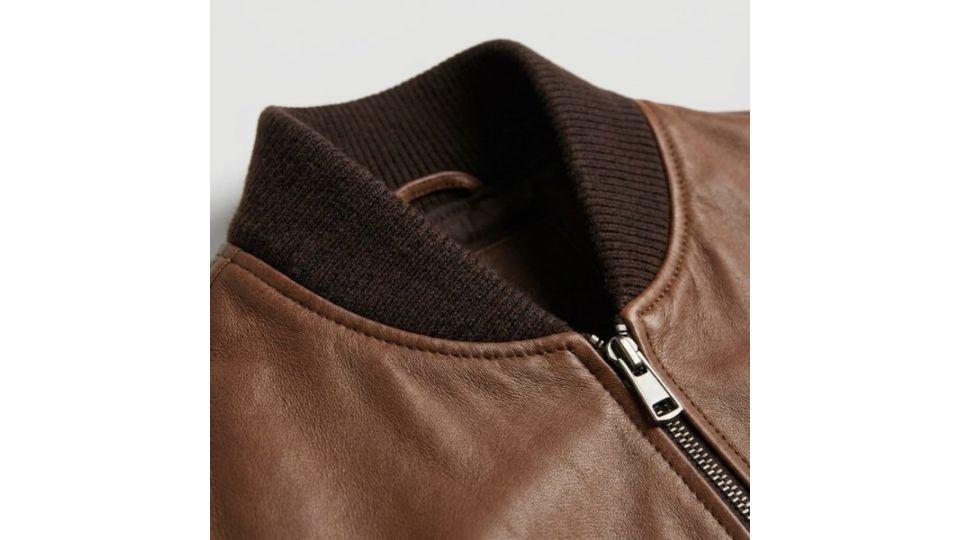
The safest way to get wrinkles out of a leather jacket is to hang it on a wide, shaped hanger in a warm room for a few days and let gravity and body heat from wearing it do the work. If creases remain, use gentle indirect steam, such as hanging it in a bathroom after a hot shower, then smooth the leather by hand. Only as a last resort, press it with an iron on its lowest setting, without steam, through a cotton cloth, for a few seconds at a time.
Each step up carries more risk than the one before it, so the trick is knowing which wrinkles are worth chasing and when to stop.
First, is it a wrinkle or a crease you should keep?
Not every line in a leather jacket is a problem. Some are the start of the character that makes old flight jackets look the way they do.
| What you see | Usual cause | Removable? | What to do |
|---|---|---|---|
| Broad, soft folds across the body or sleeves | Folding in shipping, a suitcase, or a crowded closet | Yes, usually easily | Hang it and wait; steam if needed |
| Sharp fold lines with a flattened ridge | Packed or stored folded for weeks | Mostly, with patience | Hang, then indirect steam and hand smoothing |
| Crease lines at inner elbows, shoulders and pocket tops | Wear: the leather molding to how you move | Softened, rarely erased | Leave them; they are part of the patina |
| Creases with light or cracked lines along the top | Dry leather flexing repeatedly, or finish cracking | No, the surface has broken | Clean and condition to slow it; a leather repairer can refinish |
| Puckering along seams or the lining | Lining and leather shrinking differently, often after getting wet or overheated | Rarely at home | Ask a leather repairer or tailor |
Wear creases are how a jacket becomes yours. Our guide to leather jacket patina explains why many owners want them.
The method ladder: gentlest to riskiest
Start at rung 1 and only move up when the rung below has stopped helping. Spot-test any method that uses moisture or heat on a hidden area first, and follow the care label.
| Rung | Method | Best for | Main risk | Stop if |
|---|---|---|---|---|
| 1 | Hang on a wide, shaped hanger, zipped, in a room at normal temperature for 2 to 7 days | Shipping and packing folds | Almost none | No change after a week |
| 2 | Wear it for a few hours at a time | Soft folds, stiff new leather | None | Lines remain after several wears |
| 3 | Shower steam: hang outside the spray in a closed bathroom after a hot shower for 10 to 15 minutes, then smooth by hand | Sharp fold lines | Water spots if drips land on it | The leather feels damp to the touch |
| 4 | Hand smoothing with flat weight: lay the panel flat on a towel, smooth it with your palms, place a heavy book on a cloth over the fold for a few hours | Stubborn fold on a flat panel such as the back | Pressing marks from hard edges | You see a shine or imprint |
| 5 | Handheld garment steamer held 6 to 12 inches away, kept moving, never touching | Persistent folds on sleeves and fronts | Over-wetting, spotting, darkening | The surface darkens or feels wet |
| 6 | Hair dryer on low or cool, held well away and moving, while you smooth with your hand | A small fold that steam softened but did not remove | Drying out and shrinking the area | The leather feels warm rather than lukewarm |
| 7 | Iron on its lowest setting, steam off, through a dry cotton cloth, 3 to 5 seconds per press, lifting between presses | A last, flat fold on finished, non-vintage leather | Shrinkage, scorching, shine, melted finish | Any change in color, sheen or texture |
If you reach rung 7 and the wrinkle is still there, stop. A leather cleaner or repairer has pressing equipment and experience with your type of hide.
Why heat is the dangerous part
Leather is collagen held in shape by tanning. When it is warm and damp, those fibers can contract suddenly and permanently. Leather labs measure this as shrinkage temperature. SATRA, a footwear and leather technology center, notes that vegetable-tanned leather typically shrinks at no more than about 85°C (185°F), while chrome-tanned leather is often above 100°C. Since steam adds moisture and an iron adds heat, combining them on a jacket is the riskiest thing you can do to it. That is why the ladder keeps the iron dry, low and brief, and why steam stays at a distance.
Finish the job: let it settle
- After steam or heat, hang the jacket on its shaped hanger and leave it for at least a few hours to cool and dry completely.
- If the leather feels dry or looks dull afterward, apply a light conditioner sparingly.
- Wear it. Body warmth and movement help the leather settle into its natural shape.
Preventing wrinkles in the first place
- Store it hanging on a wide, shaped hanger rather than folded or on a thin wire hanger.
- Give it space in the closet so other clothes do not press folds into it.
- When traveling, roll it loosely with tissue inside rather than folding it flat, and hang it as soon as you arrive.
- Do not hang heavy items in the pockets; they pull the front out of shape.
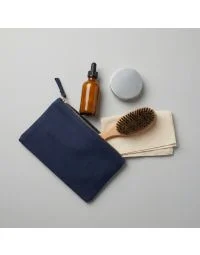
Our guide on how to store a leather jacket covers hangers and garment bags in detail. Shaped hangers, cloths and light conditioner are in our leather care range.
Bomber and flight jackets: a few specifics
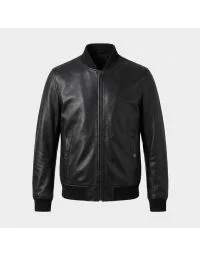
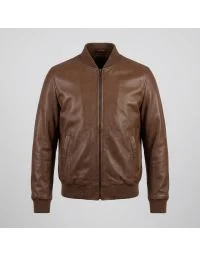
Many bomber jackets have knit cuffs and waistbands, and some have shearling or fur collars. Keep steam and heat off the knit and fleece: wool rib knit can shrink, and shearling can mat. Wrinkles on bomber jackets tend to form across the lower back and above the waistband, where the jacket bunches when you sit; those usually fall out with rungs 1 to 3. If you are choosing a new one, the cut of our leather bomber jackets is easier to keep crease-free on a proper hanger than folded in a drawer.
FAQ
Can you iron a leather jacket?
Only carefully, and only as a last resort: lowest setting, no steam, a dry cotton cloth between the iron and the leather, and a few seconds per press. Never iron suede, patent, printed or vintage leather.
Will wrinkles fall out on their own?
Packing and shipping folds usually do within a few days on a good hanger. Wear creases at the elbows do not, and are not meant to.
Can I use a fabric wrinkle-release spray?
Not on the leather. Those sprays are made for textiles and can spot or stain leather. Use them only on a fabric lining, sparingly, and let it dry before closing the jacket.
Sources
Shrinkage temperature figures come from SATRA's bulletin on leather shrinkage temperature. Hanging-storage guidance draws on the Canadian Conservation Institute's CCI Notes 13/5: Hanging Storage for Costumes. Follow your jacket's care label, and take vintage or valuable pieces to a professional leather cleaner.