
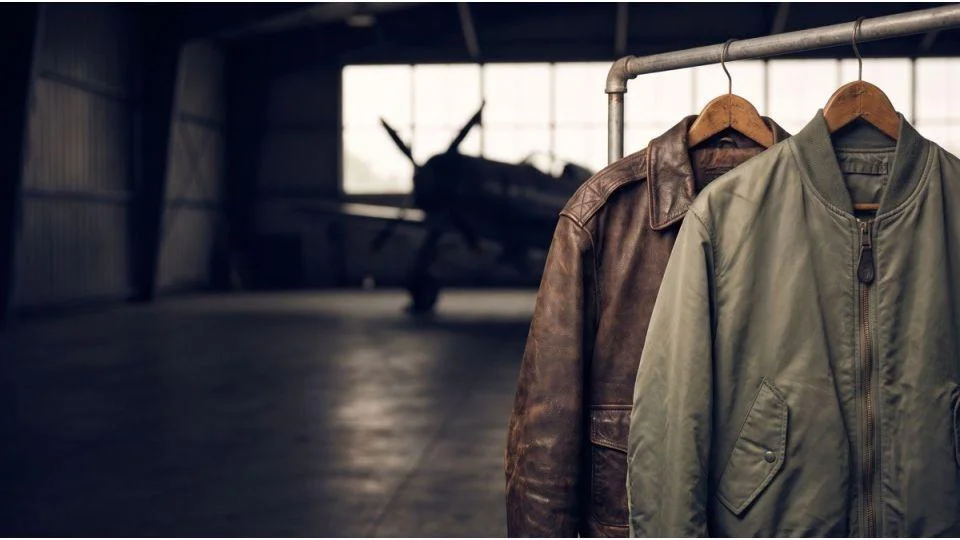
The best flight jacket for most people is decided by three questions: how cold your winters get, whether you want leather or nylon, and how hard the jacket will be worn. For mild climates and everyday style, a leather A-2 or G-1 or a nylon MA-1 covers most needs. For real cold, step up to a sheepskin B-3, a CWU-45/P style jacket or an N-3B parka. Then check the construction, because a well-made jacket in the right pattern beats a famous name in the wrong one.
This guide narrows seven classic patterns to the one or two that suit you, then gives you a 12-point checklist to judge any jacket before you buy.
The seven classic patterns in one paragraph each
A-2 (leather, mild weather)
Adopted by the U.S. Army Air Corps in 1931: a waist-length leather jacket with knit cuffs and waistband, snap-down shirt collar and two flapped patch pockets. Originally horsehide; cowhide and goatskin were later approved. Clean, simple and easy to dress up or down.
G-1 (leather, mild to cool)
The Navy's intermediate leather flight jacket, usually goatskin, recognizable by its fur or mouton collar and bi-swing back for arm movement. A little dressier and slightly warmer around the neck than the A-2.
B-3 (sheepskin, very cold)
A heavy shearling jacket with the wool on the inside and a large collar, designed for unheated, high-altitude bomber crews in the Second World War. Bulky and very warm; a city jacket only where winters are harsh.
B-15 (nylon or cotton, cool)
The transitional jacket between leather and the jet age, typically with a fur or mouton collar. The MA-1 was developed from it, partly because the bulky collar got in the way of parachute harnesses.
MA-1 (nylon, cool)
The classic nylon bomber, developed in the 1950s as an intermediate-weight jacket for jet crews, with knit collar, cuffs and waistband and, on many versions, a bright orange reversible lining. Light, packable and easy to care for. Note that nylon is not flame resistant.
CWU-45/P (Nomex® or nylon, cold)
The cold-weather successor jacket for aircrew, with a knit collar, flap pockets, a pen pocket on the sleeve and more insulation than the lighter CWU-36/P. Military versions use a Nomex® shell; many civilian versions use nylon instead, which is not flame resistant.
N-3B (parka, extreme cold)
A thigh-length hooded parka, often with a fur-trimmed hood, built for ground crews working in severe cold. The longest and warmest pattern here.
For how these designs evolved from open cockpits to jets, read our history of the flight jacket.
The chooser matrix: climate x style x budget
Climate bands here are guidance, not a rating. Your own warmth depends on layers, wind, activity and how you run hot or cold. Budget symbols are relative between patterns of similar quality, not store prices.
| Pattern | Best climate | Style | Relative budget | Care effort | Pick it if... |
|---|---|---|---|---|---|
| A-2 | Mild, spring and fall | Clean, versatile, heritage | $$ to $$$ | Medium (leather) | You want one leather jacket for most of the year |
| G-1 | Mild to cool | Heritage with a collar statement | $$ to $$$ | Medium | You like a fur collar and a little more neck warmth |
| B-3 | Cold to very cold | Rugged, bulky, dramatic | $$$ | Higher (shearling) | You face real winters and want maximum warmth from leather |
| B-15 | Cool | Vintage bomber with collar | $ to $$ | Low | You want an MA-1 shape with more character |
| MA-1 | Cool | Streetwear, casual | $ | Low (nylon) | You want an easy, light, low-maintenance bomber |
| CWU-45/P style | Cool to cold | Modern aviator, tidy | $ to $$ | Low | You want a functional pilot jacket with a cleaner collar |
| N-3B | Very cold | Utility parka | $$ | Low | Your priority is staying warm while standing still outside |
Three quick routes through the matrix
- Mild winters, one jacket: A-2 or G-1 in leather, or an MA-1 if you prefer something lighter.
- Cold winters, everyday commuting: CWU-45/P style or N-3B for the coldest days; add a leather A-2 or G-1 for shoulder seasons.
- Heritage collector: start with the A-2 or G-1, then add a B-3 when you want the cold-weather icon.
Leather or nylon?
Leather blocks wind well, molds to you over time and develops character, but it is heavier and needs occasional care. Nylon is light, cheap to care for and easy to pack, but it does not age the same way and it is not flame resistant. If you go leather, the hide matters: our comparison of horsehide vs cowhide vs goatskin vs lambskin explains the trade-offs.
A note on Nomex® and flame resistance
Nomex® is a meta-aramid fiber developed by DuPont; since April 2026 the DuPont aramids business, including the Nomex® brand, has been owned by Arclin. It is flame resistant, meaning it resists ignition and does not melt and drip the way nylon can. Fashion and heritage garments are not certified PPE; do not rely on them for firefighting, welding or other fire hazards. Nylon jackets such as the MA-1 and nylon CWU styles are not flame resistant at all.
"Authentic" flight jackets: what the word should mean
Sellers use "authentic" loosely. An original is a jacket actually made under a military contract, usually bought vintage. Almost everything new is a reproduction or a military-pattern jacket inspired by the original design. Neither is wrong; just make sure you know which you are buying, and be wary of new jackets that claim to be original issue. Our jackets are military-pattern designs inspired by the originals.
The 12-point quality checklist
Run through this on any product page or in person. Most points apply to both leather and nylon.
- Named material. The hide (horse, cow, goat, lamb, sheepskin) or shell fabric is stated, not just "genuine leather" or "nylon blend".
- Grain grade. For leather, full-grain or top-grain is stated.
- Shoulder fit. The shoulder seam sits at or just past your shoulder bone. See how a leather jacket should fit.
- Sleeve length at reach. Sleeves still reach your wrist with arms extended forward.
- Hem position. Waist-length styles finish at or just below the belt; parkas cover the seat.
- Zipper. Heavy, smooth-running, ideally metal on leather jackets; no catching on the facing.
- Stitching. Straight, even seams with no skipped stitches; reinforcement at pocket corners and zip ends.
- Knits. Cuffs and waistband are dense and spring back when stretched.
- Lining. Securely sewn, with enough ease that it does not pull when you reach.
- Pockets. Pocket bags are sturdy and pocket corners are reinforced.
- Collar. Shirt collars sit flat with snaps or hooks that close cleanly; fur or mouton collars are evenly attached.
- Care guidance. The seller gives clear care instructions and a size guide you can check against your measurements.
Sizing before you order
Flight jackets were designed to be worn over a shirt or light sweater, and leather does not stretch much in length. Measure yourself and compare with the chart on the size guide, and remember that you can choose Made to measure on the product page and enter your own measurements instead; see how made to measure works.
Where to start browsing
If you have narrowed it down, explore leather flight jackets for A-2, G-1 and B-3 patterns, nylon and textile jackets for MA-1 and B-15 styles, Nomex® flight jackets and gear for CWU patterns, and field jackets and parkas for N-3B and other cold-weather options.
Frequently asked questions
What is the warmest flight jacket?
Among these patterns, a sheepskin B-3 or an N-3B parka is warmest, with the CWU-45/P next. This is guidance, not a rating.
Is an MA-1 or a CWU-45/P better?
The MA-1 is lighter and more casual; the CWU-45/P style has a cleaner collar, flap pockets and usually more insulation. Choose by climate and look.
Can I wear a leather flight jacket in the rain?
Light rain is fine if you let it dry naturally at room temperature. For regular wet weather, a nylon jacket is easier to live with.
Sources
A-2 adoption and hides from A-2 jacket (Wikipedia). MA-1 origins and B-15 link from MA-1 bomber jacket (Wikipedia). Nomex® ownership from Textile World: Arclin completes acquisition of the DuPont Aramids business. Museum A-2 description from the Smithsonian National Air and Space Museum.